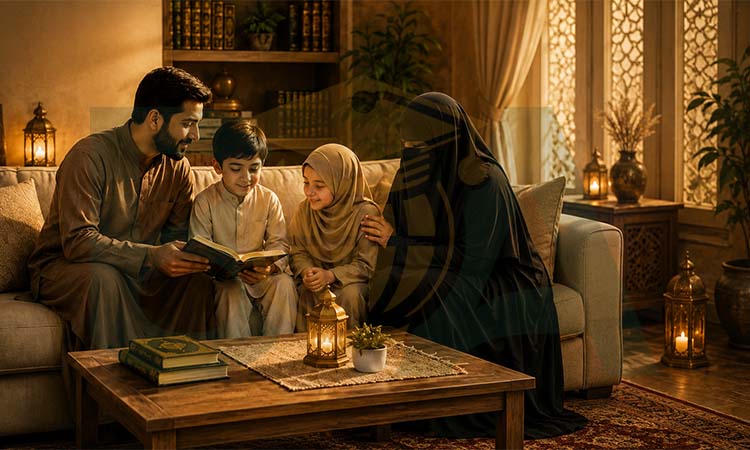
In the previous part, we discussed the responsibilities Islam places on a husband regarding the rights of his wife. A Muslim husband is responsible for his wife’s maintenance, accommodation, kind treatment, and religious upbringing. However, a family is not limited to the husband and wife alone; children are also an essential part of it.
Just as Islam has made it obligatory for children to fulfill the rights of their parents, it has also placed certain rights of children upon their parents, especially the father. A Muslim father is not only responsible for providing for his children’s worldly needs but is also accountable for their religious, moral, and practical upbringing. If he provides them with proper education, good character, and an Islamic environment, it becomes a continuous source of reward (Sadaqah Jariyah) for him. If he neglects their upbringing, he will be questioned about it on the Day of Judgment.
Children are one of the greatest blessings of Allah Almighty.
Let us now learn about some of the rights of children in the light of Islamic teachings.
(1) Right: Choosing a Righteous Mother
The very first right of a child, even before birth, is that a righteous mother should be chosen for them. A mother plays a vital role in a child’s life. The better her character and faith, the better the upbringing of the child, because the first lessons of knowledge and manners begin in the mother’s lap. Therefore, choosing a pious, well-mannered, and righteous woman for marriage is the child’s first right.
The Prophet Muhammad ﷺ said that four qualities are generally considered when marrying a woman:
(1) Her wealth, (2) her family background, (3) her beauty, and (4) her religion. Then he said: “Choose the religious one, and you will be successful.”
(Sahih al-Bukhari, Book of Marriage, Hadith: 5090)
Whether Allah blesses a person with a son or a daughter, they should always be grateful to Him.
Some people celebrate the birth of a son but become unhappy at the birth of a daughter, whereas the Prophet ﷺ mentioned great virtues regarding the birth of daughters.
The Messenger of Allah ﷺ said:
“When a daughter is born to someone, Allah sends angels to that household. They greet the family with peace, cover the child with their wings, and say: ‘A weak girl has been born from a weak woman. Whoever takes care of her will receive Allah’s help on the Day of Judgment.'”
(Al-Mu’jam As-Saghir, Vol. 1, p. 30)
(2) Right: Calling the Adhan in the Child’s Ear
It is recommended (Mustahabb) to call the Adhan in the ear of a newborn child.
Hazrat Abu Rafi’ (RA) reported:
“I saw the Messenger of Allah ﷺ call the Adhan in the ear of Hasan ibn Ali (RA) when he was born to Sayyidah Fatimah (RA).”
(Jami’ at-Tirmidhi, Hadith: 1514; Mishkat al-Masabih, Hadith: 4157)
(3) Right: Giving a Good Name
The Messenger of Allah ﷺ said:
“On the Day of Judgment, you will be called by your names and the names of your fathers, so give yourselves good names.”
(Sunan Abi Dawud, Vol. 4, p. 374, Hadith: 4948)
Therefore, instead of naming children after actors, athletes, unjust rulers, or sinful individuals, they should be named after the Prophets, the noble Companions, the blessed family of the Prophet ﷺ, and the righteous saints, so that they may receive blessings in this world and the Hereafter.
(4) Right: Performing Tahneek
It is recommended that Tahneek (placing a softened date or something sweet in the newborn’s mouth) be performed by a righteous, pious, and God-fearing person, whether a man or a woman. If such a person is not available, the newborn may be taken to a righteous person for this practice.
Sayyidah Aisha (RA) reported:
“People used to bring their newborn children to the Messenger of Allah ﷺ. He would pray for blessings for them and perform Tahneek.”
(Sahih Muslim, Hadith: 2147)
(5) Right: Performing Aqiqah
Sadr al-Shari’ah Mufti Amjad Ali A’zami (RA) stated:
“On the seventh day after the child’s birth, the child should be named, the head should be shaved, Aqiqah should be performed, and charity equal to the weight of the child’s hair in silver or gold should be given.”
(Bahar-e-Shariat, Vol. 3, p. 355)
(6) Right: Providing Halal Sustenance
It is one of the father’s important responsibilities to earn lawful (Halal) income and provide lawful food for his children.
Allah Almighty says:
وَكُلُوا مِمَّا رَزَقَكُمُ اللَّهُ حَلَالًا طَيِّبًا
Translation: “Eat from what Allah has provided for you, lawful and pure.”
(Surah Al-Ma’idah, 5:88)
(7) Right: Providing Religious Education
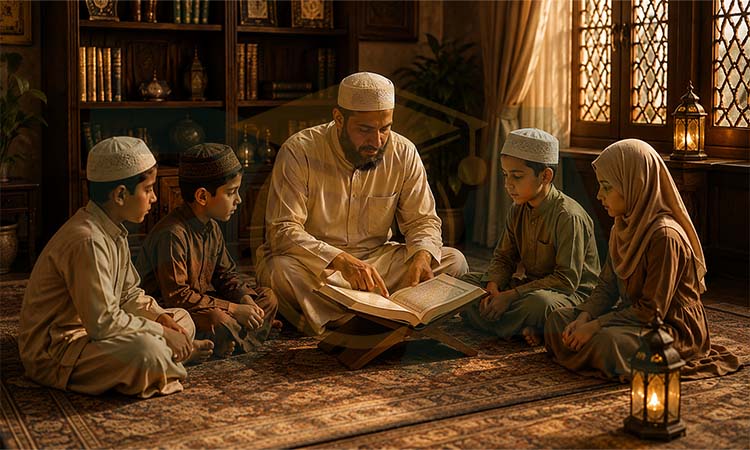
A father should ensure that his children receive a proper Islamic upbringing. From an early age, he should strengthen the beliefs and practices of Ahl al-Sunnah in their hearts, make them aware of false beliefs and misguided groups, and teach them to avoid harmful company.
He should also focus on their moral development by teaching them good manners and respect. Children should be kept away from foul language, useless activities, immoral dramas, and inappropriate films. Alongside Islamic education, they should also receive beneficial worldly education in a healthy environment free from immoral and un-Islamic influences, so they can become responsible and self-sufficient members of society.
(8) Right: Developing the Habit of Prayer
Children should be encouraged to pray from an early age. Parents should set an example by praying themselves, instruct children to perform Salah at the age of seven, and be firm about its regular observance when they reach the age of ten.
(9) Right: Teaching Love for the Qur’an and the Family of the Prophet ﷺ
The Messenger of Allah ﷺ said:
“Teach your children three things: love for your Prophet ﷺ, love for his family (Ahl al-Bayt), and the recitation of the Holy Qur’an.”
(Al-Jami’ al-Saghir, Hadith: 311)
(10) Right: Treating Children with Fairness
Parents should maintain justice and fairness between sons and daughters in love, gifts, clothing, financial support, and general treatment. A daughter deserves the same kindness, affection, and care that is shown to a son.
(11) Right: Teaching Useful Skills
Parents should recognize their children’s abilities and interests and help them develop useful skills, crafts, or professions so they can become productive and beneficial members of society.
(12) Right: Caring for Their Future and Marriage
The Prophet Muhammad ﷺ said:
“Do not delay three things: the prayer when its time arrives, the funeral when it is ready, and the marriage of an unmarried woman when a suitable match is found.”
(Fatawa Ridawiyyah, Vol. 9, p. 309)
May Allah Almighty grant us the ability to provide our children with proper Islamic, moral, and spiritual upbringing. May He make them true servants of Islam, a source of comfort for their parents, and beneficial members of the Muslim Ummah. May He also grant us the ability to fulfill our responsibilities in the best possible manner.
Ameen, through the honor of the Leader of the Messengers, Prophet Muhammad ﷺ.