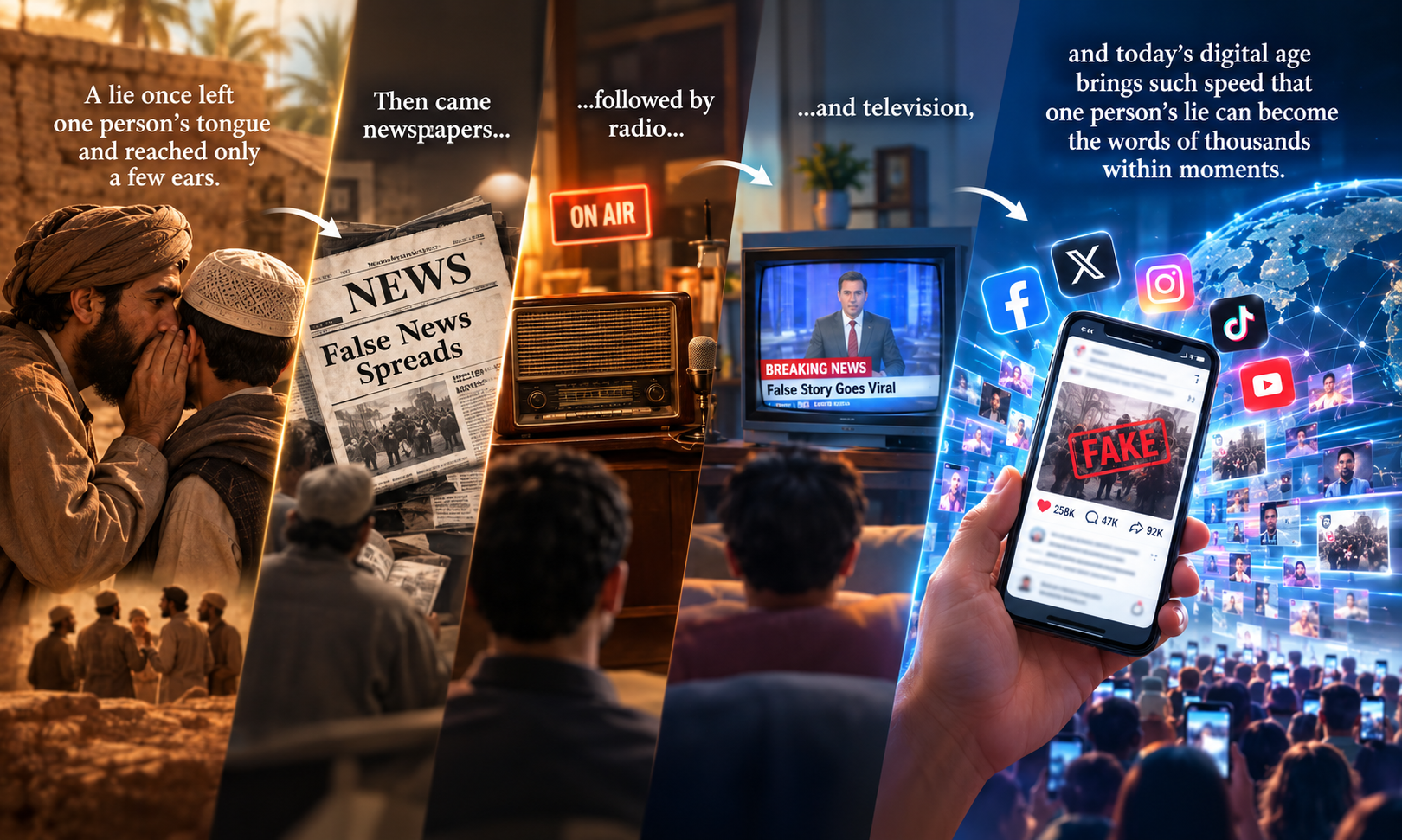
There was a time when a lie would leave one person’s tongue and reach only a few ears. Then times changed. Newspapers arrived, followed by radio and television, and the reach of falsehood continued to grow. But today’s digital age has brought with it such speed that one person’s lie can become the words of thousands within a matter of moments.
A news story appears on social media. Its headline is shocking, its image is emotionally provocative, and a person forwards it without verifying it. In this way, one person’s doubt becomes another person’s belief, and then becomes a third person’s message. Within moments, a baseless claim can take on the appearance of “truth.”
The Qur’an’s Guiding Principle
The Holy Qur’an has given humanity a great principle regarding the handling of information:
﴾يَا أَيُّهَا الَّذِينَ آمَنُوا إِنْ جَاءَكُمْ فَاسِقٌ بِنَبَإٍ فَتَبَيَّنُوا﴿
Translation:
“O believers! If an evildoer brings you any news, verify it.”
Surah Al-Hujurat, Part 26, Ayah 6
This is not merely a verse; it is a profound ethical principle for the digital age.
Today, the “source of the news” is not necessarily a person. It can be a Facebook post, a WhatsApp message, a YouTube video, or an unknown website.
The question is:
Do we verify information before accepting and sharing it?
Repeating Everything We Hear
The Messenger of Allah ﷺ said:
“It is enough for a person to be considered a liar that he narrates everything he hears.”
Sahih Muslim, Introduction, Hadith 5, Chapter: The Prohibition of Narrating Everything One Hears
Think about it!
How many things do we forward every day without even knowing whether they are true or false?
Sometimes we see:
“This news has just been received.”
Sometimes:
“Share this with everyone immediately.”
And sometimes:
“A great scholar has said this.”
But when the claim is investigated, there is neither a reliable source nor an original reference.
The fact that something has been shared by many people does not necessarily make it true.
One Dangerous Form of Falsehood: Character Assassination
One of the most dangerous forms of falsehood is damaging someone’s reputation.
An accusation is made against a person, a photograph is attached, or a short video clip is shared—and then people begin commenting.
A person who has not even been given an opportunity to explain themselves may suddenly be viewed as guilty by thousands of people.
This is not merely a social-media post. Behind it may be a person’s honour, family, livelihood, and entire social life.
The Qur’an Also Teaches Us to Protect People’s Honour
Allah Almighty says:
﴾وَلَا يَغْتَبْ بَعْضُكُمْ بَعْضًا﴿
Translation:
“And do not backbite one another.”
Surah Al-Hujurat, Part 26, Ayah 12
Today, backbiting does not happen only while sitting together in a gathering. Sometimes it is written on a screen, sometimes published as a post, sometimes written in a comment, and sometimes it occurs when someone’s private matter is exposed publicly.
The setting may have changed, but our moral responsibility remains.
The “Share” Button Is Also a Test
We must understand that the “Share” button is not merely a technological button; it is also a test of our moral responsibility.
If the information is false, we are not merely people who read it—we may become people who spread it.
Therefore, whenever we come across a piece of news, we should ask three questions:
Where did this information come from?
Is there reliable evidence to support it?
And if it turns out to be false, who will be responsible for the harm it causes?
A Moment of Verification Can Prevent Great Harm
Remember:
No matter how fast falsehood spreads, a Muslim’s verification should be faster.
A moment of haste can take away someone’s honour, while a moment of verification can prevent a major conflict or harm from spreading.
Therefore, before forwarding any news, pause, think, and verify.
Perhaps that one moment of caution will protect someone’s dignity and prevent serious harm from spreading.
A Prayer
May Allah Almighty grant us the ability to understand these teachings and act upon them. May He grant us the wisdom to verify every piece of information, protect the honour of others, and refrain from spreading false or unverified claims.
Ameen, for the sake of the Noble Prophet ﷺ.
A Humble Request
After reading this article, please share it with other groups, friends, and family members so that awareness of verification, responsibility, and truthfulness may spread in the digital age.